
AI Was Not the Headline in These Conversations. That Might Be the Point
I recently recorded three Tech Caddie podcast episodes that, when viewed together, form a clear snapshot of where golf technology stands today.
One conversation was with Rusty Grimm, founder of Rustic Golf Properties, a fast-growing operator now managing six golf facilities. Another featured Vache Hagopian, General Manager of Jonas Synergy, discussing the launch of a new platform inside one of the largest technology companies in golf. The third was with Jason Patronas and Mike Dickoff of Apparation, exploring what it means when live tee time availability begins surfacing inside ChatGPT through Primo Tee Times.
An operator. A major technology leader. Two entrepreneurs challenging long-standing norms around tee time aggregation.
They belong together because they represent three seats in the same room. And the contrast across those conversations reveals something the industry should pay close attention to.
AI was central for the innovators. It was adjacent for the enterprise technology leader. And with the owner-operator, the person truly driving the engine of golf, AI never came up.
That absence is not a criticism. It is a signal.
Innovators: AI as a new playing field

In the conversation about tee times hitting ChatGPT, AI is not treated as a feature. It is treated as a shift in terrain.
Primo Tee Times and Apparation are thinking beyond booking flows. They are focused on discovery and distribution in a world where golfers increasingly ask questions through conversational interfaces. That raises entirely new questions about ownership, attribution, accuracy, and the role of aggregators when the interface is no longer a website or marketplace, but an assistant.
In that context, AI becomes unavoidable. It forces new thinking about where demand originates and who controls the relationship with the golfer. These are not incremental changes. They are structural ones.
Enterprise platforms: foundations before acceleration
The Jonas Synergy conversation sits in a different place. It is rooted in scale, reliability, and operational clarity.
Synergy is positioned around simplifying golf-first workflows for private clubs, improving accessibility across devices, and reducing friction in day-to-day operations. The emphasis is not automation for its own sake, but consistency, integration, and usability.
That matters for the AI conversation. AI rarely fixes disorder. It amplifies what already exists. Platforms that are easier to navigate, easier to query, and better integrated are far more likely to support meaningful AI assistance later. In that sense, Synergy represents foundational work that makes AI practical over time, rather than performative today.
Operators: the engine still runs on execution
Then there is the operator conversation.
Listening to Rusty Grimm describe leasing, acquiring, staffing, managing food and beverage, running resort golf, and navigating technology changes across multiple properties is a reminder of how golf actually operates day to day.
Operators do not wake up thinking about AI strategy. They wake up thinking about payroll, staffing gaps, guest expectations, equipment issues, and whether today will run smoothly.
In this conversation, AI never enters the discussion. Not once.
That does not mean operators are resistant to innovation. Operators adopt new technology constantly. They adopt it when it clearly maps to outcomes they can feel.
Which leads to the real takeaway from these three episodes.
This is not resistance. It is a translation gap.
AI adoption in golf is not stalled because operators do not care. It is stalled because the benefits have not always been framed in operator language.
Operators live in a time-deficit economy. They care about fewer interruptions, clearer answers, smoother workflows, and better discovery without more work. When AI is framed as “the future,” it remains abstract. When it is framed as “you will get hours back every week,” it becomes relevant.
That is why data matters.
What the data shows: AI absorbs interruptions
As part of my PGA Show work around AI in golf operations, I surveyed golf facilities using CourseRev for AI telephone management. The results were consistent.
One hundred percent of respondents reported measurable weekly time savings. None reported zero impact.
Sixty percent estimated savings of four to six staff hours per week. The remaining forty percent estimated savings of one to three hours.
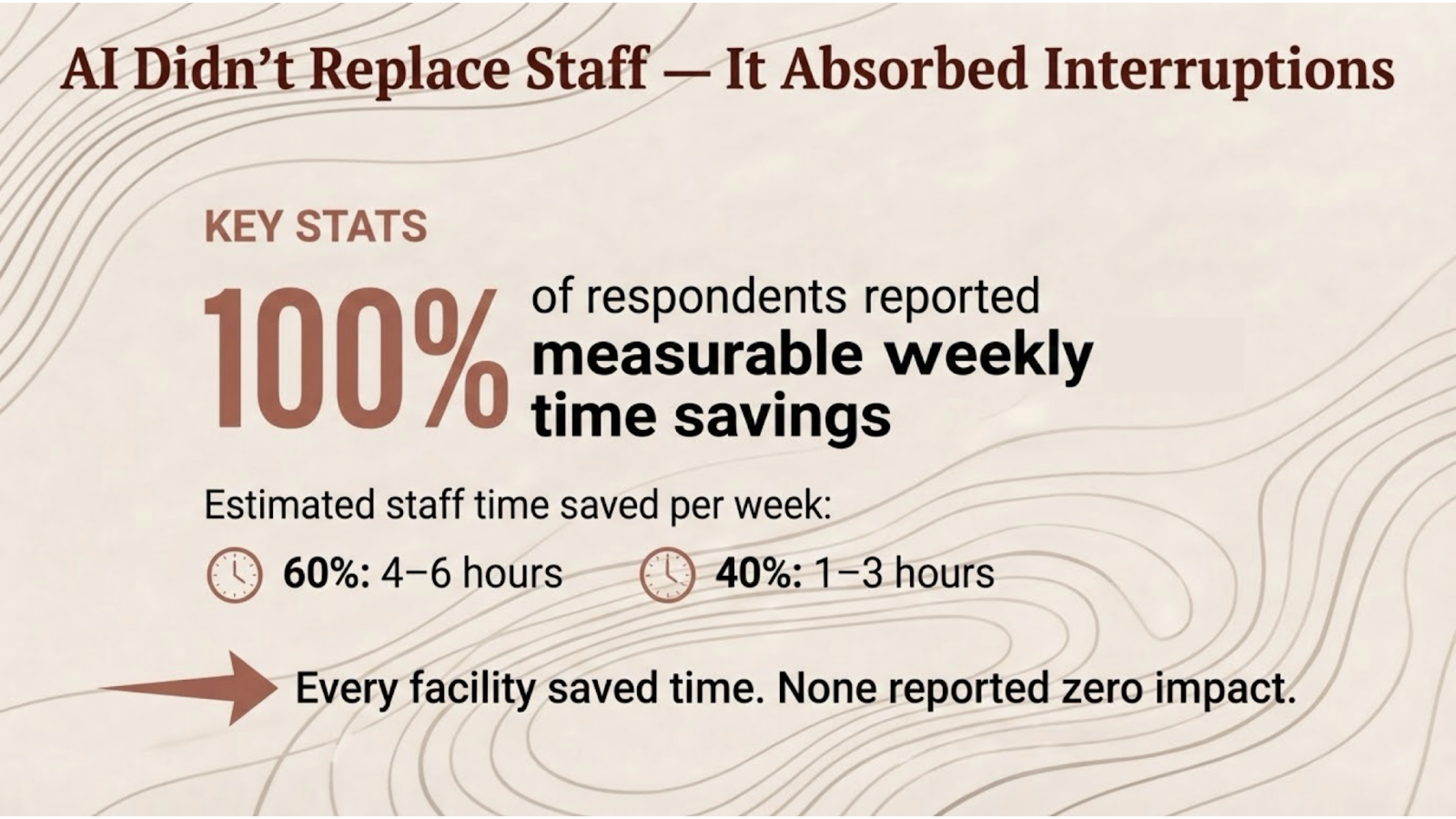
The most important nuance is how that time was recovered. Staff were not working faster. Staff were interrupted less.
AI did not replace staff. It absorbed interruptions.
In golf operations, where the phone is a constant source of disruption, that distinction matters.
A broader market is forming
CourseRev is not alone in this space. Sagacity Golf has introduced a product line under the Sagacity AI name and is seeing meaningful growth in client adoption, along with reported facility-level impact.
GOLF.AI has also begun expanding its B2B footprint after an earlier consumer rollout. The company now supports live golf facilities, including a course in Texas using an AI telephone concierge. Future deployments are expected to leverage the voice of Sir Nick Faldo, a move that highlights how quickly AI in golf is evolving from utility into differentiated experience.
Taken together, these efforts point to the same conclusion. AI telephone management is no longer experimental. It is becoming an operational layer.
Time recovery extends beyond the phone
Telephone management is only one example.
Another emerging area of time recovery is AI-assisted reporting and guidance. Club Caddie, a sister company to Jonas Synergy, has drawn attention for enabling operators to pull reports and ask questions more naturally, without navigating complex menus or exports. AI Partners is pursuing a similar approach, focused on helping operators interact with their own data more efficiently.
These tools do not change what operators want to know. They change how quickly and easily operators get answers.
Again, the pattern holds. The value is not novelty. The value is fewer steps, fewer clicks, and fewer interruptions.
The real work ahead
AI is already reshaping how innovators think about tee time discovery and how platforms think about long-term product direction. But it is not yet part of how many operators talk about their business.
That gap is not something to criticize. It is something to address.
The industry’s job is not to preach AI. It is to translate AI into time recovered, interruptions avoided, and decisions made faster.
When the benefits become defined and irrefutable, adoption will follow.
That is where the next phase of golf technology will be won.
What are golfers really saying about your course?
Get a free one-page RAI Snapshot: your Review Advocacy Index, average stars and rating mix from the last 12 months of Google reviews.
Get my free RAI Snapshot


