
Reach Golfers

Videos

Reach Golfers

Product Features and Services

Geofencing

Multiple options for turf protection & cart traffic control, including Cart Path Only. Geofencing supports options that enhance golfer safety, inform golfers about course policies / services & strategically place promotional/marketing opportunities.

In-Cart Transactions

Our interactive screens support multiple options for F&B orders, replay tee time offers, bounce back tee time offers, and course-specific or hole-specific promotions.

Look-ahead Technology

Displays other carts on the same hole where blind-shots cause pace delays and safety issues.

Integrations & APIs

POS, golf tee times and tee sheets, pin positions, plus APIs to let your technology partners get detailed cart history data to enhance your customer profile with on-course behavior, purchases, and pace.

AI-Powered Pace of Play Monitoring

A trained AI model that recognizes problematic groups, alerts staff, and can optionally automatically message problem carts with factual language to address the challenge.

About our pricing

Monthly Pricing Includes: - High-res, weatherproof, cart-mounted touchscreens with Reach Golfers’ proprietary power solution - 3D artistic rendering of all holes and clubhouse - On-site, white-glove installation that includes device assembly, geofence testing, and staff training - 2 batteries per unit and charging stations for all batteries - Dedicated Customer Success Manager for ongoing support

About our support

Every customers has a dedicated Customer Success Manager for ongoing support. We provide on-site, white-glove installation that includes device assembly, geofence testing, and staff training.

About our roadmap

We’re building the future of on-course golf technology. Our mission is to connect brands, courses, and players in meaningful ways to provide exceptional on-course experiences for every golfer.

Reach Golfers

Go To Website
No items found.
No items found.

Golf Cart Tracking

Enhance your golf course management with Golf Cart Tracking technology. Utilize GPS technology to monitor and optimize cart usage, to create a seamless experience for both staff and golfers.
No items found.

More about

Reach Golfers

Go To Website

Comprehensive Strategic Analysis Report: Reach Golfers (IZON Technology, LLC)

1. Executive Summary

1.1 Introduction and Investment Thesis

Reach Golfers, the principal trade name for the golf-specific vertical of IZON Technology, LLC, has emerged as a disruptive force at the convergence of three substantial industries: sports technology, golf course operations management, and Digital Out-of-Home (DOOH) advertising. Headquartered in Scottsdale, Arizona, the company has engineered a platform that digitizes the golf cart fleet—a historically analog asset—transforming it into a connected, data-rich node within the Internet of Things (IoT). By outfitting golf carts with high-definition, GPS-enabled touchscreens, Reach Golfers creates a dual-value ecosystem: it provides course operators with enterprise-grade fleet management and pace-of-play tools, often at zero direct capital cost, while simultaneously generating a high-value, captive media network for advertisers seeking access to the affluent, hard-to-reach golfing demographic.1

The core investment thesis for Reach Golfers is predicated on the scarcity of attention in the modern digital economy. As traditional digital advertising channels (web, mobile, social) become increasingly saturated and subject to viewability fraud and ad-blocking technologies, advertisers are shifting capital toward "captive audience" environments. The golf course represents one of the few remaining sanctuaries where high-net-worth individuals are engaged in a leisure activity for a prolonged duration—typically 4.5 hours per round—without the distractions of work or domestic life.4 Reach Golfers capitalizes on this dwell time by integrating digital engagement directly into the workflow of the game. Unlike a billboard that is passed in seconds, the Reach Golfers screen is an essential utility for the golfer, providing yardage data, scoring, and food ordering capabilities, ensuring repeated and sustained interaction throughout the round.1

Furthermore, the company has successfully transitioned from a direct-sales model to a programmatic-first architecture. By integrating with leading Supply-Side Platforms (SSPs) such as Vistar Media and Place Exchange, Reach Golfers has unlocked access to national digital advertising budgets.6 This strategic pivot allows the company to monetize its inventory via Real-Time Bidding (RTB) exchanges, where demand from Tier-1 advertisers like FanDuel and the Arizona Lottery can instantly access their network of screens.1 This scalability distinguishes Reach Golfers from legacy competitors who rely on labor-intensive local sales of static inventory, such as paper scorecards or tee signs.

1.2 Market Position and Competitive Moat

The "Green Grass" technology sector is characterized by high fragmentation and distinct barriers to entry. Reach Golfers occupies a unique position as a hardware-enabled media network. While competitors such as Gallus Golf focus on mobile application ecosystems that rely on the golfer's own device, and OEMs like Club Car’s Visage system focus on factory-integrated hardware, Reach Golfers targets the vast aftermarket. Their solution is fleet-agnostic, capable of being retrofitted onto any major cart brand (EZ-GO, Yamaha, Club Car), which dramatically expands their Total Addressable Market (TAM) beyond the replacement cycle of new cart fleets.3

The company's primary competitive moat is its "Zero Cost to Course" business model. In an industry where golf course operators are notoriously cost-conscious and capital-constrained, Reach Golfers removes the financial friction of adoption by subsidizing the hardware and software costs through advertising revenue.3 This model creates a defensible network effect: as more courses adopt the platform to save on technology costs, the network's reach grows, attracting larger advertising budgets, which in turn supports further expansion. Additionally, the company's intellectual property, specifically the "IZON REACH" ad server and "IZON Side Games" gamification engine, enhances screen dwell time and ad recall, creating a stickier product than passive GPS displays.9

Leadership plays a pivotal role in the company's market positioning. The involvement of Tim Ummel (Founder & CEO) and Don Rea Jr. (VP of the PGA of America and owner of Augusta Ranch Golf Club) provides significant industry validation.3 In a sector often plagued by "fly-by-night" vendors and scam operators selling non-existent advertising exposure, the visible endorsement of a high-ranking PGA of America official serves as a powerful signal of legitimacy and operational viability.

1.3 Key Operational and Technological Insights

From a technological standpoint, the Reach Golfers platform acts as an edge-computing device with real-time bi-directional communication capabilities. A critical innovation is the system's power management architecture. The "Smart" battery charging stations and the ability to operate independently of the cart's drivetrain address a major operational pain point: the risk of aftermarket accessories draining electric cart batteries and voiding manufacturer warranties.3 This "Zero Cart Battery Reliance" feature significantly de-risks the installation for fleet managers.

Data governance is another cornerstone of the operational model. The platform engages in granular data collection, capturing precise geolocation data to power geofencing and pace-of-play algorithms.1 This data transforms the golf course operations center, allowing pro shop staff to visualize the entire field of play, identify slow groups (bottlenecks), and send targeted messages to specific carts to accelerate play—directly impacting the course's revenue throughput capacity.3 Simultaneously, this data is aggregated to create "verified impressions," a currency essential for trading on programmatic DOOH platforms, ensuring advertisers pay only for validated exposure.

1.4 Financial and Strategic Outlook

While Reach Golfers operates as a private entity, the economics of its business model suggest a trajectory toward high-margin maturity. Once the initial hardware capital expenditure is amortized, the marginal cost of serving digital advertisements is negligible, while the CPM (Cost Per Mille) commanded by the golf demographic is substantial—often 5x to 10x higher than standard web display inventory.11 The potential for courses to earn revenue shares of "up to $17,000 per year" indicates robust unit economics that allow for value sharing with partners.3

Strategically, Reach Golfers is well-positioned to benefit from the post-pandemic surge in golf participation. The "COVID bump" brought millions of new players to the sport, expanding the addressable audience and increasing the utilization of golf courses nationwide.12 However, the company faces headwinds, including the operational challenge of maintaining distributed hardware in harsh outdoor environments and the increasing competition for "screen time" from golfers' own mobile devices. The analysis suggests that Reach Golfers is successfully mitigating these risks by deeply integrating into the operational fabric of the course—making the screen indispensable for F&B ordering and yardage—thereby ensuring it remains the primary digital interface during the round.

1.5 Summary of Recommendations

  • For Capital Allocators: Reach Golfers represents a mature growth-stage opportunity in the DOOH vertical. Due diligence should focus on hardware durability, programmatic fill rates, and the contract renewal rates of course partners.
  • For Golf Course Operators: The platform offers a compelling value proposition for modernizing operations without capital outlay. Operators should prioritize understanding the revenue share tiers and ensuring data ownership rights are clearly defined.
  • For Brand Advertisers: The platform provides a verified, brand-safe environment with exceptional dwell time. It is particularly effective for brands in the financial services, automotive, and sports betting sectors looking to drive measurable lower-funnel actions.

2. Corporate Intelligence and Governance Structure

2.1 Corporate Entity, Identity, and Structure

Reach Golfers operates as the primary market-facing brand for the golf vertical of IZON Technology, LLC. The company is a limited liability company incorporated in the United States, with its operational headquarters located in the tech-centric corridor of Scottsdale, Arizona.

  • Legal Identity: IZON Technology, LLC
  • Trade Name: Reach Golfers (also frequently referred to as "IZON" or "IZON Network" in historical contexts).
  • Headquarters: 18291 N Pima Rd, Suite #110-372, Scottsdale, AZ 85255-5696.2
  • Geographic Focus: The company operates primarily within the United States, with ad network capabilities extending across 40 states.13
  • Related Entities: The corporate lineage includes references to "IZON Network," "IZON 3 Agency" (focused on Web 3.0, NFTs, and blockchain applications for golf architecture), and "IZON Ride" (a proposed vertical for rideshare advertising).9 This suggests a broader strategic vision of a diversified "IZON" media holding company, of which Reach Golfers is the flagship "Green Grass" implementation.

The choice of Scottsdale as a headquarters is strategic. The Phoenix-Scottsdale metropolitan area is a global hub for the golf industry, hosting the headquarters of major equipment manufacturers (e.g., PING), management companies (e.g., Troon), and the PGA Tour's Waste Management Phoenix Open. This proximity allows IZON Technology to maintain close physical and relational proximity to key industry decision-makers and testbed facilities.2

2.2 Leadership Profile and Strategic Vision

The executive leadership of IZON Technology combines entrepreneurial acumen with deep-rooted industry authority, a necessary blend to navigate the relationship-driven golf business.

2.2.1 Tim Ummel – Founder and Chief Executive Officer

Tim Ummel serves as the Founder and CEO of IZON Technology. His professional background is characterized by a transition from corporate structures to entrepreneurial ventures. Ummel's career began with a strong foundation in rural agriculture, fostering a work ethic he cites as pivotal to his leadership style.16 He subsequently entered the sports agency sector, specializing in the rebranding of professional athletes in golf and baseball. This experience provided him with a nuanced understanding of athlete marketing and brand management. Ummel's leadership philosophy is described as "entrepreneurial," emphasizing direct accountability ("the buck stops with me") and a willingness to disrupt traditional corporate models. Under his direction, IZON has evolved from a hardware-centric provider to a sophisticated media network, emphasizing the integration of programmatic advertising technologies and the expansion into Web 3.0 applications.14

2.2.2 Don Rea Jr. – Strategic Partner and Industry Evangelist

Perhaps the most significant asset in IZON's governance structure is its relationship with Don Rea Jr. As the Vice President of the PGA of America and owner/operator of Augusta Ranch Golf Club, Rea represents the highest echelon of industry governance and practical course ownership.3

  • Operational Validation: Rea uses Augusta Ranch as a living laboratory for IZON's technology, publicly validating its impact on course operations and revenue generation.3
  • Institutional Credibility: In an industry wary of technology vendors due to past "vaporware" and scams, Rea's endorsement acts as a powerful trust signal. His role bridges the gap between the theoretical benefits of the tech and the practical realities of the "pro shop counter."
  • Thought Leadership: Through podcasts and industry speaking engagements, Rea articulates the operator's perspective on technology, advocating for systems that drive revenue (RevPAR) and improve customer experience, aligning perfectly with Reach Golfers' value proposition.10

2.3 Organizational History and Brand Evolution

The trajectory of IZON Technology illustrates a responsive evolution to market demands. Initially established with a focus that touched on nanotechnology and biology (creating some brand confusion with New Zealand-based Izon Science), the company crystallized its mission around the "Internet of Things" (IoT) in the golf space.15

  • Phase 1: Hardware Utility: Early iterations focused on the utility of GPS for the golfer—replacing laser rangefinders and yardage books.
  • Phase 2: The IZON Network: The company recognized that the hardware was a commodity, but the screen was a media asset. This led to the formation of the "IZON Network," aggregating screens to sell advertising inventory.15
  • Phase 3: Reach Golfers & Programmatic: The current phase, branded as "Reach Golfers," emphasizes the audience rather than the device. This rebrand aligns with the language of modern media buyers, focusing on "reach," "impressions," and "engagement" rather than "GPS accuracy." The integration with ad-tech partners like Vistar Media and Adomni marks the maturity of this phase, moving ad sales from manual insertion orders to automated programmatic pipes.9

2.4 Legal Standing and Litigation Landscape

A review of legal databases and public records reveals a complex landscape surrounding the "IZON" name and the broader patent environment for diagnostics, but specifically for IZON Technology LLC of Scottsdale, the legal standing appears stable regarding its core operations.

  • Patent Litigation Context: While search snippets reference "Roche Diagnostics v. Meso Scale Diagnostics" and "IZON Science," these appear to be distinct entities or unrelated patent disputes not directly implicating the Scottsdale-based golf technology firm.20
  • Differentiation from "Scam" Operators: It is critical to distinguish Reach Golfers from entities like "Direct Fairways" or "Bench Craft Company." These companies have faced severe consumer complaints and Better Business Bureau (BBB) scrutiny for failing to deliver on advertising promises (e.g., selling ads on scorecards that are never printed).21 Reach Golfers operates in the digital domain where "verified impressions" serve as proof of performance, inherently insulating them from the specific "non-delivery" accusations that plague print vendors. However, the company must constantly operate against this backdrop of skepticism, necessitating a higher burden of proof in its sales process.

3. The Golf Industry Macro-Environment: The "Green Grass" Economy

3.1 The Post-COVID Renaissance and Participation Metrics

The golf industry is currently enjoying a sustained period of growth often referred to as the "COVID Bump." The pandemic, which limited indoor recreational activities, positioned golf as a safe, socially distanced outdoor activity. This catalyzed a massive influx of new and returning participants.

  • Participation Volume: The National Golf Foundation (NGF) estimates the total U.S. golf reach at approximately 138 million people (including off-course engagement like Topgolf). On-course participation has seen over 3 million beginners annually since 2020, a historic rate of adoption.12
  • Latent Demand: There exists a significant pool of "latent demand," with over 24 million Americans expressing high interest in playing golf on a course, suggesting the growth runway is not yet exhausted.12
  • Demographic Shift: The stereotypical golfer demographic (older, male) is evolving. The junior segment now comprises 3.7 million participants, with 35% being female, indicating a diversification that broadens the appeal for advertisers beyond traditional "male-centric" brands (e.g., whiskey, wealth management) to broader consumer categories.12

3.2 The Psychology of the "Captive Audience"

The economic engine of Reach Golfers is the "dwell time" inherent in the sport.

  • Duration: A typical round of golf lasts between 4 to 5 hours. For approximately 60-70% of this time, the golfer is seated in the cart, traveling between shots or waiting for the group ahead.4
  • Frequency of Interaction: An average golfer takes roughly 84 shots per round (excluding putts where the cart is parked). This necessitates interacting with the cart screen at least 50-60 times per round to check yardage to the pin, hazards, or the scorecard. This high-frequency, utility-driven interaction creates a "captive audience" dynamic that is virtually non-existent in other media channels.4
  • Attention Quality: Unlike a roadside billboard passed at 65 mph or a web banner ignored due to "banner blindness," the golf cart screen provides critical information (yardage) that the user must look at to play the game effectively. This ensures that advertisements placed alongside this data receive "cognitive attention," not just peripheral visibility.24

3.3 The "Screen Economy" vs. "Digital Detox"

A tension exists within the industry regarding the digitization of the course. A segment of the golfing population views the course as a sanctuary from technology—a "digital detox" zone.

  • The Purist Perspective: High-end private clubs often resist visible technology, preferring traditional caddies or unmarked carts to preserve the natural aesthetic and tranquility of the game.
  • The Modernist Perspective: The majority of public, resort, and semi-private courses (Reach Golfers' primary market) cater to a modern consumer who expects connectivity. This golfer wants to stream music, see sports scores, track their handicap digitally, and order food without waiting. Reach Golfers bets on the "Modernist" trend, positioning the screen as an enhancement to the experience rather than a distraction.1

4. Technological Architecture and Product Ecosystem

Reach Golfers provides a vertically integrated solution comprising ruggedized hardware, a proprietary operating system, and a cloud-based ad server.

4.1 Hardware Architecture: The Connected Cart

The physical unit is the foundation of the network. It must withstand harsh environmental conditions (rain, extreme heat, vibration) while delivering a consumer-grade user experience.

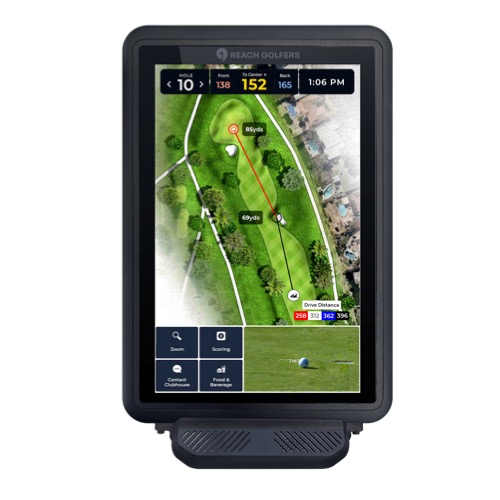
ComponentSpecification / FeatureStrategic AdvantageDisplay10.4" High-Definition Touchscreen (Weather Resistant)Large canvas for ads; readability in direct sunlight.Power SystemIndependent "Smart Battery" / Daisy-Chain ChargingCritical Moat: Does not drain the electric cart's main battery, preserving range and warranties.3Connectivity4G LTE / 5G CellularReal-time bi-directional data flow; no reliance on spotty course Wi-Fi.MountingUniversal Bracket SystemFleet agnostic; fits Club Car, EZ-GO, Yamaha.SensorsHigh-Precision GPS / Geofencing ModuleEnables sub-meter accuracy for yardage and asset protection.

The "Smart Battery" innovation is particularly noteworthy. Many competitor systems tap into the golf cart's 48V drivetrain. This can reduce the cart's playing range (a disaster for courses with 36-hole days) and void the manufacturer's warranty on the expensive cart batteries. By providing an independent power solution or a smart management system, Reach Golfers eliminates a primary objection from fleet managers.3

4.2 Software Capabilities: The "IZON" OS

The operating system is designed to serve two distinct user groups with conflicting needs: the Golfer (who wants fun and utility) and the Operator (who wants control and speed).

4.2.1 Golfer-Facing Features (Utility & Engagement)

  • 3D GPS Mapping: Offers "flyover" visualizations of holes, precise distances to the pin (Front/Center/Back), and hazard information. This replaces the need for personal rangefinders.1
  • Digital Scorecard: Allows for intuitive scoring, often integrated with the World Handicap System (WHS).
  • F&B Ordering: The "Cart-to-Clubhouse" feature enables golfers to browse a digital menu and order food/drinks from anywhere on the course. The order is printed in the kitchen/bar, and the golfer picks it up at the turn or has it delivered. This frictionless commerce increases the average check size.3
  • IZON Side Games: A gamification layer that allows golfers to play skins, wolf, or other betting games on the screen. This increases "dwell time" on the screen significantly, creating more ad inventory.9

4.2.2 Operator-Facing Features (Fleet Management)

  • Pace of Play Monitoring: The system provides a real-time heatmap of the course. Algorithms detect when a group falls behind the target pace. The Pro Shop can send a polite, pre-set message to that specific cart (e.g., "Please close the gap to the group ahead"), reducing the need for confrontational marshal interactions.1
  • Geofencing & Asset Protection: Operators can draw virtual perimeters around greens, bunkers, and environmentally sensitive areas. If a cart breaches this zone, the screen can flash a warning, audibly alert the driver, or (depending on integration depth) disable the cart. This reduces turf damage and repair costs.1
  • Battery Monitoring: Real-time state-of-charge monitoring for the fleet (if integrated), preventing carts from dying on the furthest hole.

4.3 The "IZON REACH" Ad Server

The monetization engine is the IZON REACH ad server. This proprietary technology manages the complex logic of ad delivery in a moving vehicle.

  • Contextual Triggers: Ads are not served randomly. They can be triggered by:
    • Location: A beer ad displays as the cart approaches the 9th green (the "turn").
    • Time: A breakfast sandwich ad displays before 10:00 AM.
    • Event: A "Hole-in-One Insurance" ad displays on a Par 3.
  • Verification: The system logs every impression, recording the time, location, and duration of the display. This data is fed back to the programmatic partners to validate the spend.1

5. The Digital Out-of-Home (DOOH) Ad Market Analysis

Reach Golfers operates within the rapidly expanding DOOH sector, which is projected to grow as digital ad spend migrates from online (web/mobile) to physical world screens.

5.1 Programmatic DOOH (pDOOH) Architecture

The company has successfully integrated into the programmatic supply chain, a critical evolution for scalability.

  • Supply-Side Platforms (SSPs): Reach Golfers partners with Vistar Media and Place Exchange.6 These platforms ingest the inventory (available screen time) from Reach Golfers and make it available to the global market.
  • Demand-Side Platforms (DSPs): Advertisers (agencies or brands) use DSPs (like The Trade Desk, DV360) to bid on this inventory.
  • The Transaction: An advertiser sets a targeting parameter (e.g., "Males, Household Income >$150k, Arizona"). When a Reach Golfers cart is active, the SSP sends a bid request. The DSP bids. If won, the ad is served instantly via cellular connection. This automation allows Reach Golfers to monetize inventory without a massive internal sales force.

5.2 Comparative CPM Analysis

The "Cost Per Mille" (cost per thousand impressions) is the standard currency of advertising. Golf inventory commands a significant premium due to the audience quality.

Media ChannelTypical CPM RangeCharacteristicsStandard Web Display$2.00 - $5.00Low viewability, fraud risks, ad blockers.Social Media (FB/Insta)$8.00 - $15.00High targeting, but fleeting attention (scroll).General DOOH (Billboards)$7.00 - $12.00High reach, low engagement (passersby).Place-Based DOOH (Gyms/Offices)$10.00 - $20.00Captive audience, specific demographic.Reach Golfers (Golf Cart)$15.00 - $50.00+100% Viewability, 4+ Hour Dwell, High Net Worth.

Data synthesized from industry averages and snippet 11 indicating golf course CPMs around $6.74-$8.17 for base inventory, with premium interactive inventory (like Reach Golfers) trading significantly higher in direct deals.

5.3 Revenue Model: The Subsidized Hardware Strategy

Reach Golfers employs a "Hardware-as-a-Service" (HaaS) model where the hardware cost is subsidized by ad revenue.

  • The Offer: IZON provides the screens, mounts, and software to the course for $0 upfront or a nominal installation fee.
  • The Trade: In exchange, IZON retains the rights to the ad inventory on the screens.
  • Revenue Share: IZON shares a percentage of the ad revenue with the course. Marketing materials claim courses can make "up to $17,000 per year".3 This transforms the GPS system from a cost center (expense) to a profit center (revenue generator).

6. Competitive Analysis and Strategic Positioning

The market for on-course technology is crowded, but segmented.

6.1 Direct Competitors: The "Screen on Cart" Segment

6.1.1 Visage (Club Car) / Yamatrack (Yamaha)

  • Model: OEM Integration. The screen comes factory-installed on the new cart.
  • Pros: Seamless integration, deep vehicle diagnostics.
  • Cons: Expensive capital lease addition. Only works with that specific cart brand.
  • Reach Golfers Differentiation: Reach Golfers is fleet agnostic. A course with a mixed fleet or an older fleet can install Reach Golfers, extending the life and tech-capability of older assets without buying new carts.8

6.1.2 FairwayiQ

  • Model: Operations-First. Uses small tags/sensors, not large media screens.
  • Philosophy: Focuses on pure data, pace of play, and workforce management. Explicitly critiques ad-supported models as intrusive.26
  • Reach Golfers Differentiation: Reach Golfers argues that the screen is the value. The golfer wants the screen for GPS and food ordering. The operational data is a byproduct, not the sole product.

6.2 Indirect Competitors: The "Bring Your Own Device" Segment

6.2.1 Gallus Golf (Mobile Apps)

  • Model: Branded mobile apps for courses.
  • Pros: Low cost, leverages golfer's phone. Good for booking and push notifications.28
  • Cons: "Friction." Golfer must download app, unlock phone every shot, drain battery. Phone is often left in the bag.
  • Reach Golfers Differentiation: "Always On." The cart screen is passive and always visible. No download required.

6.3 The "Scam" Competitors: Paper & Legacy

  • Bench Craft Company / Direct Fairways:
    • Model: Sell ads on paper scorecards/benches.
    • Reputation: Plagued by BBB complaints and allegations of non-fulfillment.21
    • Reach Golfers Differentiation: Trust & Verification. Reach Golfers uses the transparency of digital ad servers to prove performance. They are selling technology, not printed promises.

7. Operational Analysis: Impact on Course Management

For the Golf Course Operator (General Manager/Director of Golf), Reach Golfers impacts three critical P&L lines:

7.1 Revenue Throughput (Pace of Play)

A slow golf course loses money. If a round takes 5 hours instead of 4, the course loses tee time slots.

  • Mechanism: Reach Golfers tracks every cart.
  • Action: The Pro Shop identifies a gap.
  • Result: The system nudges the slow group. Even a 10-minute reduction in average round time allows for one extra tee time group per day. Over a year, this equals tens of thousands of dollars in green fee revenue.

7.2 Food & Beverage (F&B) Capture

F&B is often the second largest revenue stream.

  • Problem: The "Turn" (between hole 9 and 10) is a bottleneck. Golfers wait in line, slowing play.
  • Reach Solution: Digital ordering from the 8th fairway.
  • Economic Impact: Increases "capture rate" (percentage of golfers buying food) and check average (upselling via screen visuals). It also improves kitchen efficiency by pacing orders.3

7.3 Agronomy and Maintenance

  • Problem: Carts driving on wet fairways or near greens cause thousands of dollars in turf damage.
  • Reach Solution: Geofencing alerts.
  • Economic Impact: Reduced labor hours for turf repair and extended lifespan of the course conditions.24

8. Case Studies and Performance Metrics

The efficacy of the Reach Golfers platform is validated by documented campaign results.

8.1 Case Study: FanDuel (Customer Acquisition)

  • Context: Sports betting legalization in Arizona created a "land grab" for new users.
  • Strategy: Target golfers (high overlap with sports bettors) during live sporting events (weekends).
  • Execution: Dynamic ads on Reach Golfers screens offering sign-up bonuses.
  • Results:
    • 159% Increase in App Downloads.
    • 95.5% Overall Performance Lift compared to other channels.
    • 24.1 Million Verified Impressions delivered.1
  • Analysis: This demonstrates the platform's ability to drive conversion, not just awareness. The "captive" nature of the cart allowed golfers to download the app during the round (perhaps while waiting at a tee box).

8.2 Case Study: Arizona Lottery (Brand Lift)

  • Context: Need to modernize the lottery brand and reach a younger, affluent demographic.
  • Strategy: Utilize the "IZON Side Games" or interstitial ads to promote excitement around scratchers and Powerball.
  • Results: Contributed to record-breaking sales and transfers for the state.30
  • Analysis: Shows the versatility of the platform for state-level agencies looking for hyper-local but high-volume reach.

9. Data Privacy, Regulation, and Ethical Considerations

9.1 The Data Harvest

Reach Golfers collects three layers of data:

  1. Geolocation: Where the cart is every second.
  2. Interaction: What the golfer touches (Menu items, ads clicked, score entered).
  3. Identity: If the golfer logs in for a handicap or pays for food, PII is captured.1

9.2 Privacy Policy and Compliance

  • Transparency: The company's privacy policy (IZON) discloses the collection of "Usage Data" and "Personal Data" and sharing with "Affiliates".1
  • Regulatory Framework: As a US-based entity, they primarily adhere to US privacy norms (Notice and Choice). However, the programmatic ecosystem (Vistar/Place Exchange) requires strict adherence to privacy standards to prevent the leakage of PII in bid requests. The system likely anonymizes data before sending it to the bid stream (e.g., sending "Cart ID 123 at location X" rather than "John Doe at location X").
  • Risk: The "God's Eye View" of player movement raises surveillance concerns. Private clubs may require strict data siloing to ensure member privacy is not commoditized.

10. Strategic Outlook and Risk Factors

10.1 Future Growth Vectors

  1. IZON Ride: Expansion of the screen network into rideshare vehicles (Uber/Lyft). This leverages the same ad server technology but applies it to a different captive audience.9
  2. Real-Time Betting Integration: With the explosion of micro-betting (betting on the outcome of a single shot), Reach Golfers is positioned to become the interface for on-course wagering, subject to regulatory approval.
  3. Sustainability: Solar-powered carts and "energy-neutral" screens will become a priority as courses look to reduce their carbon footprint.

10.2 Risk Assessment

  • Hardware Failure: The failure rate of electronics in desert heat or coastal salt air is high. A broken screen is a dark screen, which means zero revenue. Maintenance logistics are a significant operational cost.
  • Ad Market Cyclicality: The business model is heavily levered to advertising demand. In a recession, ad budgets are cut, potentially exposing the company to hardware costs without offsetting revenue.
  • Golfer Pushback: If the ads become too intrusive (e.g., video with sound that cannot be muted), the "premium" experience degrades, and courses may remove the units to protect their brand.

10.3 Conclusion

Reach Golfers (IZON Technology) represents a sophisticated maturation of the golf technology market. By pivoting from a hardware sales model to a programmatic media network, they have aligned their incentives with both course operators (who want free tech) and advertisers (who want captive audiences). The company's deep integration with the PGA of America governance structure and its verified performance metrics (FanDuel case study) create a formidable competitive moat against both legacy print scammers and mobile-app competitors. The primary challenge ahead lies in scaling the hardware network efficiently while navigating the evolving landscape of data privacy and user experience.