
ChatGPT Local Results Are Now Featuring a Knowledge Panel
Why Golf Courses Must Treat Their Website as the Primary Source of Truth
Mike Hendrix
Founder, smbGOLF
ChatGPT has quietly rolled out a new feature that matters more to golf courses than most operators realize: local results that surface a Knowledge Panel–style business card when users click brand links or map buttons.
If this sounds familiar, it should. The experience resembles Google’s Knowledge Panel—but it’s being generated inside ChatGPT, and it’s already appearing across local categories like restaurants, car dealers, and home services. It also shows up for brand-based searches (for example, “Subway locations”).
What’s important for golf courses—both public and private—is how these panels are built and where the information comes from.
What These Panels Look Like
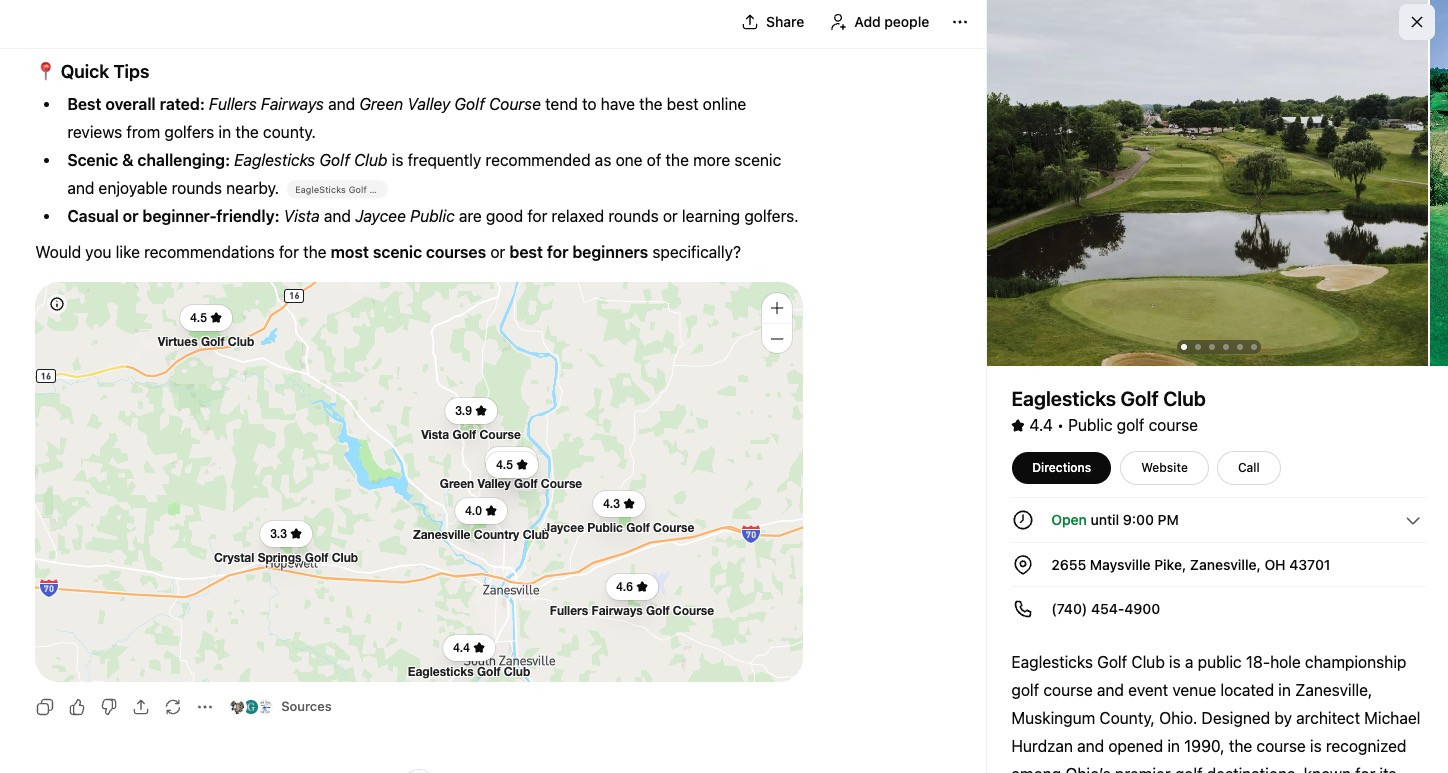
A typical local result still begins with conversational text and a bulleted list of recommendations. But when a user clicks a firm name, star rating, or map pin, ChatGPT now opens an entity-level Knowledge Panel for that business.
That panel generally includes:
- A large image (clickable into a photo carousel)
- Buttons for Directions, Website, and Call
- Hours of operation
- Address and phone number
- A series of descriptive sections, such as:
- Course and Design
- Facilities and Amenities
- Recognition and Rankings
- Events and Dining
- Address / Phone
- Website and Third-Party Citations
The headings vary by type of golf facility: Public / Private. In private, "Facilities and Membership" and "Legacy"
This variability is exactly why golf courses need to pay attention.
Why This Matters for Golf Courses
Golf courses are uniquely complex local businesses. They aren’t just a place with an address and phone number—they operate tee sheets, leagues, memberships, lessons, food and beverage, events, simulators, range facilities, and increasingly hybrid public-private models.
When ChatGPT assembles a Knowledge Panel for a golf property, it’s attempting to answer every question a golfer might ask, including:
- Is this course public or private?
- Can I book a tee time online?
- Do they have a driving range or simulators?
- Is food available?
- Who owns or operates the course?
- Where do I book lessons?
- What’s the reputation like?
If your website is not the most complete, accurate, and clearly structured source of that information, ChatGPT will fill in the gaps using third-party data—and that’s where things can go wrong. We are seeing inappropriate pictures, old websites formatted with vip.teeitup.golfcoursename.com, and rarely a mention of simulator options.
These Panels Are Not a Knowledge Graph
One of the most important observations here is that ChatGPT does not appear to be relying on a proprietary local knowledge graph the way Google does. We found this observation via Near Media and Greg Sterling.
Based on analysis of the underlying markup, these panels are being dynamically generated using:
- Reconciled business facts from multiple third-party providers (MapQuest is explicitly referenced)
- Google Business Profile–style data patterns
- Opportunistic image sourcing from Yelp, Wikipedia, LoopNet, and the specific business websites.
- AI-generated summaries created through retrieval-augmented generation (RAG)
In plain terms:
ChatGPT is stitching together what it can find, then summarizing it.
That means results can vary. It also means accuracy is only as good as the sources being pulled in.
The Risk for Golf Properties
Golf courses that don’t control their own narrative risk:
- Incorrect public vs. private classification
- Outdated hours or contact info
- Third-party booking links being surfaced instead of first-party ones
- Poor or irrelevant images representing the property
- Incomplete descriptions of amenities and offerings
This is not theoretical. We already see these issues regularly in Google, Apple Maps, and booking marketplaces. ChatGPT is now becoming another discovery layer—and it’s learning from the same messy ecosystem.
The Website Must Be the Source of Truth
At smbGOLF, we’ve been consistent about this position:
A golf course website must be the primary source of truth for every question, every time.
That means:
- Clear, crawlable descriptions of what the property is and is not
- Explicit statements about public access, memberships, and booking rules
- Accurate, well-structured content about amenities, lessons, events, and food
- Clean internal linking to booking engines, apps, and policies
- Alignment between the website, Google Business Profile, and other citations
ChatGPT is not “reading” your site the way a human does. It’s extracting, reconciling, and summarizing. The more precise and authoritative your site is, the more likely it becomes the grounding source for AI-generated answers.
A Positive Development—With a Catch
This new Knowledge Panel experience is a positive step for ChatGPT. Better local UX is critical if it wants to compete seriously with Google in discovery and decision-making.
But for golf courses, it reinforces a reality that’s already here:
AI engines are becoming the front door.
If your website isn’t built to answer questions clearly, consistently, and authoritatively, someone—or something—else will do it for you.
And you may not like the answer.
Go here to hire us to fix this for you: https://web.smbgolf.com/golf-course-search-optimization


