
Google Maps Can Now Sell Your Halfway House Burger — Here's Why That Matters for Golf
Toast just gave golf course restaurants a distribution channel that most operators didn't know they were missing.
On August 6, 2026, Toast (NYSE: TOST) announced an expanded partnership with Google that plugs its ordering system into Ask Maps, Google's conversational AI feature inside Google Maps. When someone asks Maps — by voice or text — for a place to eat nearby, Ask Maps can now surface a Toast restaurant's menu directly in the response and carry that guest all the way through to a completed order, without ever leaving the app.
For restaurants generally, Toast is framing this as a way to convert casual discovery into revenue. For golf, it's something more specific: a rare, low-friction way to put a course's food and beverage program in front of people who have never set foot on the property.
From search to order, without a detour
The mechanics are straightforward. A user opens Google Maps, asks for a lunch recommendation, and Ask Maps can respond with a Toast-powered restaurant's menu — then complete the order right there. Toast is positioning three things as the core value: restaurants get discovered at scale inside a search moment guests are already using; the path from finding a place to ordering from it collapses into one flow; and because orders route through Toast's own first-party system, operators pick up volume without layering on third-party marketplace commissions.
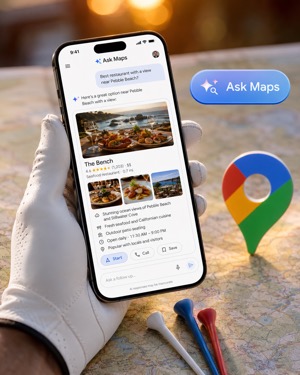
Toast is also subsidizing early adoption. Starting in late August, any guest who places a qualifying order ($30+, paid via express checkout) through a Toast restaurant via Ask Maps receives $5 in Toast Cash, redeemable on their next order through the Toast Local app — a mechanic clearly designed to turn a one-time Maps order into a repeat guest relationship.
Underneath the announcement is a longer-term bet: Toast is a co-developer of the Universal Commerce Protocol (UCP) for Food, an open standard for how AI agents discover, order from, and check out with restaurants across Search, Maps, and Gemini. Ask Maps is an early expression of that standard, not a one-off feature — which suggests this kind of AI-mediated discovery is going to keep showing up across more Google surfaces, not fewer.
Why this is a bigger deal for golf than it looks
On the surface, this reads as a restaurant-industry story. But golf course clubhouses, grills, and halfway houses are, functionally, restaurants that almost nobody outside the gate knows exist.
Michael Fox, Senior District Manager – Golf at Toast, put it this way:
"Every golf course in America is sitting on a restaurant that nobody outside the property knows exists — that's real F&B capacity that's historically been invisible unless you were already there to play. This integration puts a course's menu in front of someone searching for lunch two miles away who has never picked up a club. That's not just incremental orders, it's an entirely new customer segment discovering the property. And once they've been on site for a burger, they're a lot closer to booking a tee time, an outing, or a wedding."
That's the mechanism worth sitting with. Most course F&B outlets have historically depended almost entirely on golfers already booked to play — the menu essentially doesn't exist to the surrounding community. Ask Maps changes the addressable audience for that grill from "people already on property" to "anyone within range asking their phone where to eat." A course's turkey club now competes for attention the same way a nearby diner or fast-casual spot does, purely on the strength of having a Toast-connected menu ready to be surfaced.
An ordering feature that functions like a marketing channel
Fox frames the bigger opportunity in terms familiar to anyone thinking about a course's Digital Hospitality gap — the distance between how good the operation actually is and how visible that operation is to people who haven't found it yet:
"For a golf operator, this is a marketing channel as much as an ordering channel. Most courses have no realistic way to reach the local non-golfer, and that's the audience that fills new player programs, the lesson tee, event calendars, and your patio on a Friday night. Showing up in Google Maps when someone asks where to eat nearby introduces the property to people who'd never have thought to look. The order is the entry point — the relationship with the course is what you're actually building."
That reframes the KPI. A course chasing this integration shouldn't just be counting incremental lunch tickets — the real prize is impressions and visits from a non-golfing local audience that most acquisition strategies never reach. Those are the same people operators are already trying to find for new-player programs, group lessons, banquet and wedding leads, and off-peak patio traffic. A burger order via Ask Maps is a cheap, practically frictionless first touch with exactly that audience — arguably cheaper and more targeted than most local advertising a course could otherwise buy.
What operators should do now
The integration is rolling out with the Toast Cash promotion beginning in late August 2026. For golf operators running Toast at their F&B outlet, the practical to-do list is short but has a real time cost attached to getting it right:
- Get the Toast-connected menu accurate and complete. If Ask Maps is going to be the front door for people who've never seen the property, the menu needs to look like it belongs to a real restaurant — full items, pricing, and descriptions — not an afterthought behind the pro shop.
- Treat the Google Business Profile as part of the funnel. Hours, photos, and location accuracy all feed how — and whether — a course surfaces in an Ask Maps response.
- Plan for the on-site conversion, not just the order. If the strategic value is turning a walk-in lunch guest into a new-player prospect or event lead, staff and signage at the grill should be doing some of that work — a card for the golf shop, a QR code to the lesson program, a mention of upcoming open events.
- Watch how UCP for Food develops. Because Toast is helping build the underlying protocol, this kind of AI-agent discovery is likely to expand to Search and Gemini next, not stay confined to Maps.
The headline here is an ordering feature. The actual opportunity for golf is discovery — a channel that, for the first time, lets the course's kitchen introduce the property to people the pro shop was never going to reach.
Source: Toast, "Arriving Now: AI-Powered Toast Ordering on Google Maps," August 6, 2026
Take food and drink orders from anywhere on the course
Fairway Bites lets golfers order from their phones and staff handle it from theirs. No admin panel required.
See Fairway Bites


